
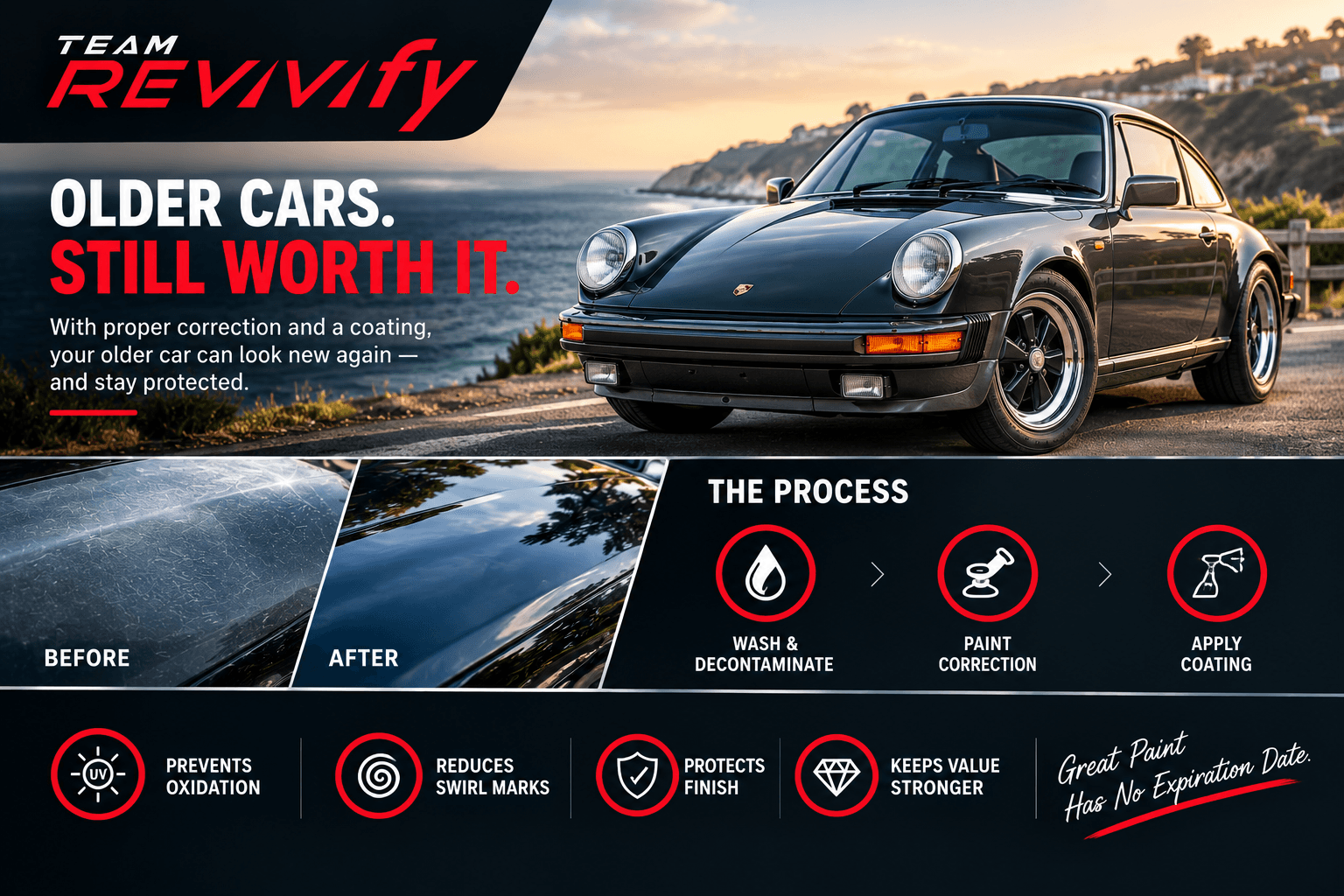
Yes, you should coat a car that isn't new — as long as the paint is structurally sound. Older paint usually needs correction first to remove swirl marks, oxidation, and etching, but once that's done, a coating locks in the restored finish and protects it going forward. The only cars that aren't good candidates are those with failing clear coat, heavy previous respray work, or damage that correction can't safely address.
Last updated: September 2026
Why do people think coatings are only for new cars?
Because a coating is transparent — it preserves whatever condition the paint is in when it's applied. On a new car, that condition is close to perfect, so coating immediately makes obvious sense. On an older car, the assumption is that the paint is "too far gone." Usually it isn't. Most tired-looking paint is swirled and oxidized on the surface, not structurally failed, and that surface layer is exactly what paint correction restores.
How do you know if an older car is a good candidate?
Good signs:
- Paint looks dull or swirled but is smooth and intact to the touch after a clay decontamination
- No flaking, peeling, or "clear coat failure" cloudiness (usually seen first on the roof and hood)
- Any previous body work is solid and color-matched
A professional will measure paint thickness before correcting, because older cars — especially ones that have been machine-polished before — have less clear coat to work with.
What does the process look like on an older car?
Wash, decontamination, paint-thickness readings, then multi-stage machine correction to remove defects, a panel wipe to strip polishing oils, and finally the coating applied panel by panel. On an older car the correction stage is longer than on a new one — that's where most of the time and cost goes, and it's what makes the coating worth applying.
Is a self-healing coating a good choice for an older daily driver?
It's arguably the better choice. An older car that lives outside goes through years of thermal cycling. A flexible, elastomeric self-healing coating like SH Lite or CarbonX flexes with the panel and lets light new swirl marks self-level with heat, which keeps a corrected finish looking corrected for longer.
When is it not worth it?
If the clear coat is already failing, no coating will save it — that panel needs paint. If the car is a short-term keeper you'll sell within months, a lighter-duty option or a graphene sealant may make more sense than a full correction and coating. And if a shop offers to coat an older car without proposing any correction, that's a red flag — they'd just be sealing in the defects.
Revivify is based in Huntington Beach and works on Orange County vehicles of all ages through trained applicators.
FAQ
Can you coat a car with existing swirl marks?
You can, but you shouldn't without correcting first. The coating will lock the swirl marks in permanently and they'll be visible under the gloss.
Does an older car need more than one correction stage?
Often yes. Years of washing create deeper defects that a single polishing pass won't fully remove. The installer assesses this after a test spot.
Is it too late if my paint is already oxidized?
Usually not. Light to moderate oxidation is a surface issue that correction removes. Severe oxidation that has reached the color coat is the exception.
How long will a coating last on older paint?
The coating itself performs the same as it would on new paint — its lifespan depends on the product tier and maintenance, not the age of the car underneath it.