
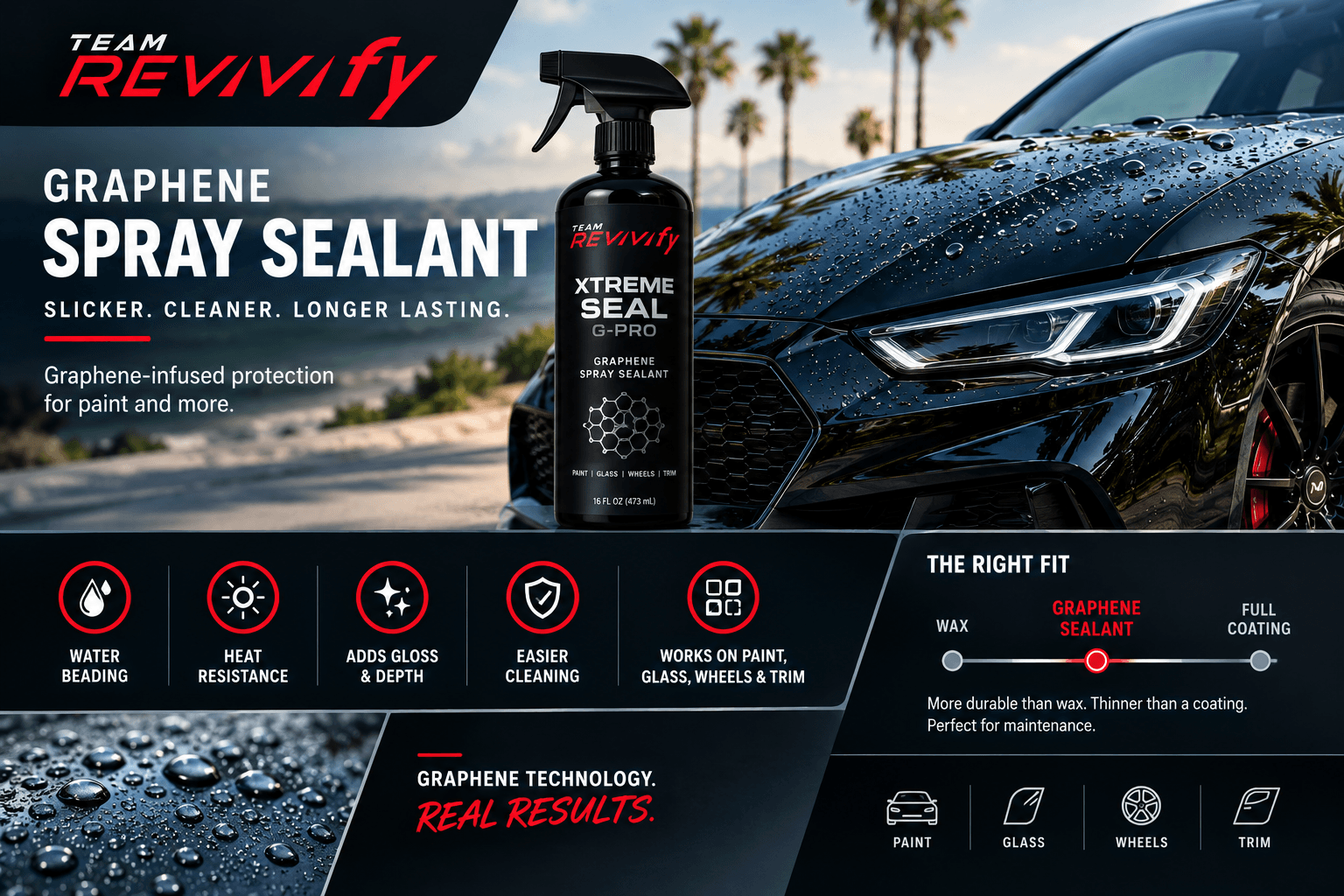
A graphene spray sealant is a fast-apply protective layer that uses graphene-infused chemistry to deliver water beading, heat resistance, and reduced water spotting on paint and other hard surfaces. It sits between a traditional wax and a full professional coating: longer-lasting and slicker than wax, but thinner and shorter-lived than a bonded self-healing coating. It's a maintenance product, not a substitute for a full install.
Last updated: September 2026
How is graphene different from ceramic chemistry?
Traditional "ceramic" products rely on silica (SiO2). Graphene is a carbon-based material, and in a sealant it's valued for two things: it's very slick, and it dissipates heat well, which reduces the water-spotting that happens when beads dry on a hot panel in the sun. That heat behavior is a real advantage in Southern California, where a rinsed car can flash-dry in minutes.
What does a graphene spray sealant actually do?
- Adds strong hydrophobic beading and sheeting
- Makes the surface easier to clean between washes
- Reduces water spots on hot panels
- Adds gloss and depth
- Works on paint, glass, wheels, and trim
Revivify's Xtreme Seal G-Pro is a graphene spray sealant in this category, and there's a graphene-infused fabric protector, Textile G-Pro, for interiors, upholstery, and carpet.
How long does a graphene sealant last?
Generally a few months per application, depending on wash frequency, sun exposure, and whether it's layered over a coating or applied to bare paint. That's longer than most waxes and shorter than a bonded coating. It's designed to be reapplied easily as part of a wash routine.
Should you use a sealant or a full coating?
They're not either/or. A full self-healing coating like CarbonX or Ultra Pro is the durable base layer that provides years of protection and self-healing. A graphene spray sealant is what you use on top to refresh beading and gloss between professional services, or as standalone protection on a vehicle that doesn't warrant a full coating. Using the sealant does not replace correcting and coating the paint properly the first time.
Can you put a graphene sealant on a coated car?
Yes — that's one of its best uses. Applied over an existing coating, it tops up the slickness and water behavior without affecting the coating underneath. Just make sure the surface is clean first so you're not sealing dirt in.
Revivify, based in Huntington Beach, makes self-healing coatings and graphene sealants for automotive, marine, and aviation surfaces.
FAQ
Is a graphene sealant the same as a graphene coating?
No. A sealant is a thin, fast-apply, shorter-lived layer. A true coating is thicker, bonds harder, and lasts years. The word "graphene" describes the chemistry, not the durability class.
Does graphene really stop water spots?
It reduces them. Graphene's heat dissipation means beads are less likely to bake mineral deposits onto a hot panel, but no product makes water spotting impossible — rinsing and drying still matter.
Can I use a graphene sealant on glass and wheels?
Yes. It works on most exterior hard surfaces, including glass, wheels, and trim.
Will a sealant protect bare paint through a Southern California summer?
It helps, but a few months of coastal sun will wear it down. For a car parked outside year-round, a full coating is the more reliable base.