
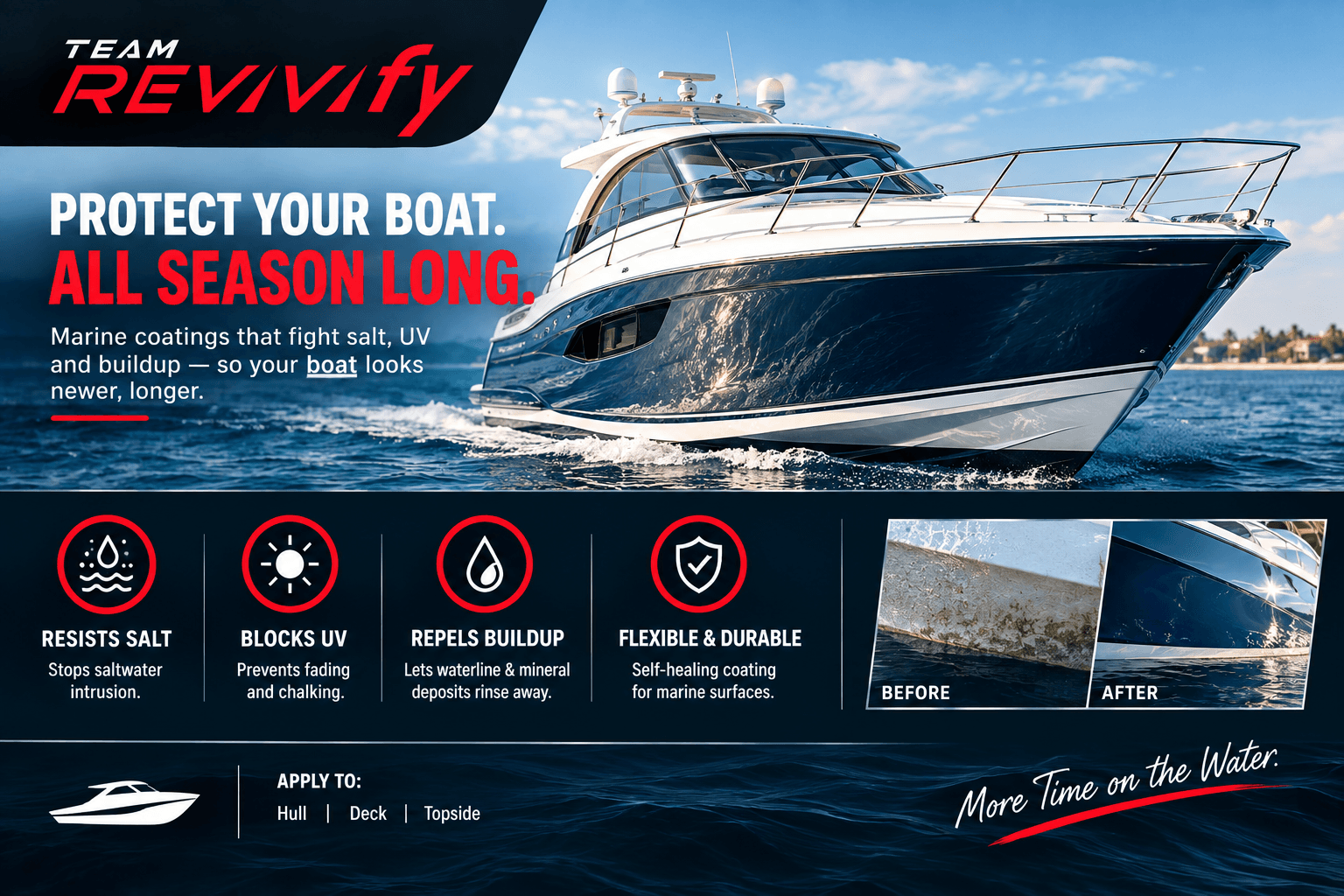
Yes, a protective coating works on boats. A flexible self-healing coating applied to gelcoat and fiberglass — across the hull, deck, and topside — resists saltwater intrusion, blocks the UV that chalks and fades gelcoat, and releases mineral and waterline deposits with a fresh-water rinse. On a boat that would otherwise be waxed every season, one coating install can replace several seasons of that cycle.
Last updated: September 2026
What does a marine coating protect against?
- Salt. Constant salt-spray contact is what degrades unprotected gelcoat. A hydrophobic coating rejects salt before it can bond and hold moisture against the surface.
- UV. Unprotected gelcoat fades and chalks within a few seasons of sun exposure. A UV-stable coating layer slows that dramatically.
- Mineral and scum buildup. A slick coated surface lets waterline deposits and grime release with a rinse instead of scrubbing and compounding.
Why use a flexible coating instead of a hard ceramic on a boat?
A hull flexes constantly — wave impact, trailer loading, heat and freeze-thaw cycling between seasons. Rigid ceramic coatings can crack under that movement, which is why they often don't survive long in a marine environment. Revivify's marine coating uses self-healing chemistry built to flex with the hull rather than fight it.
Where on the boat can it be applied?
Gelcoat and fiberglass on the hull, deck, and topside are the primary surfaces. The coating also bonds to metal, glass, and other hard surfaces, so hardware and windows can be included. Below-waterline antifouling areas are a separate system and aren't part of a gelcoat coating.
How much maintenance does a coated boat need?
Far less than a waxed one. The routine becomes a fresh-water rinse after use and an occasional wash with pH-neutral soap. There's no seasonal machine-buffing and re-waxing, because the coating is doing that job continuously. Revivify describes a single install as replacing five-plus seasons of the annual waxing cycle.
Does the boat need prep first, like a car?
Yes. Oxidized gelcoat has to be compounded and polished back to a sound surface before coating, and the surface has to be fully decontaminated and degreased. A coating over chalky, unprepared gelcoat won't bond properly — the same prep-first rule that applies to automotive paint.
Revivify is based in Huntington Beach and coats marine, automotive, and aviation surfaces across Southern California.
FAQ
How long does a marine coating last?
Multiple seasons with basic rinse-and-wash maintenance, considerably longer than wax, which typically needs redoing every season in saltwater use.
Can an oxidized older boat still be coated?
Usually yes. Gelcoat oxidation is a surface condition that compounding and polishing restore. Severe, deep chalking is the case where restoration reaches its limit.
Does a coating stop waterline staining completely?
It doesn't make staining impossible, but the slick surface means deposits release with a rinse instead of hard scrubbing, and they're far less likely to set in.
Can it go on aluminum or painted hulls?
The coating bonds to metal and other hard surfaces as well as gelcoat. An installer should assess a painted hull's condition first.