
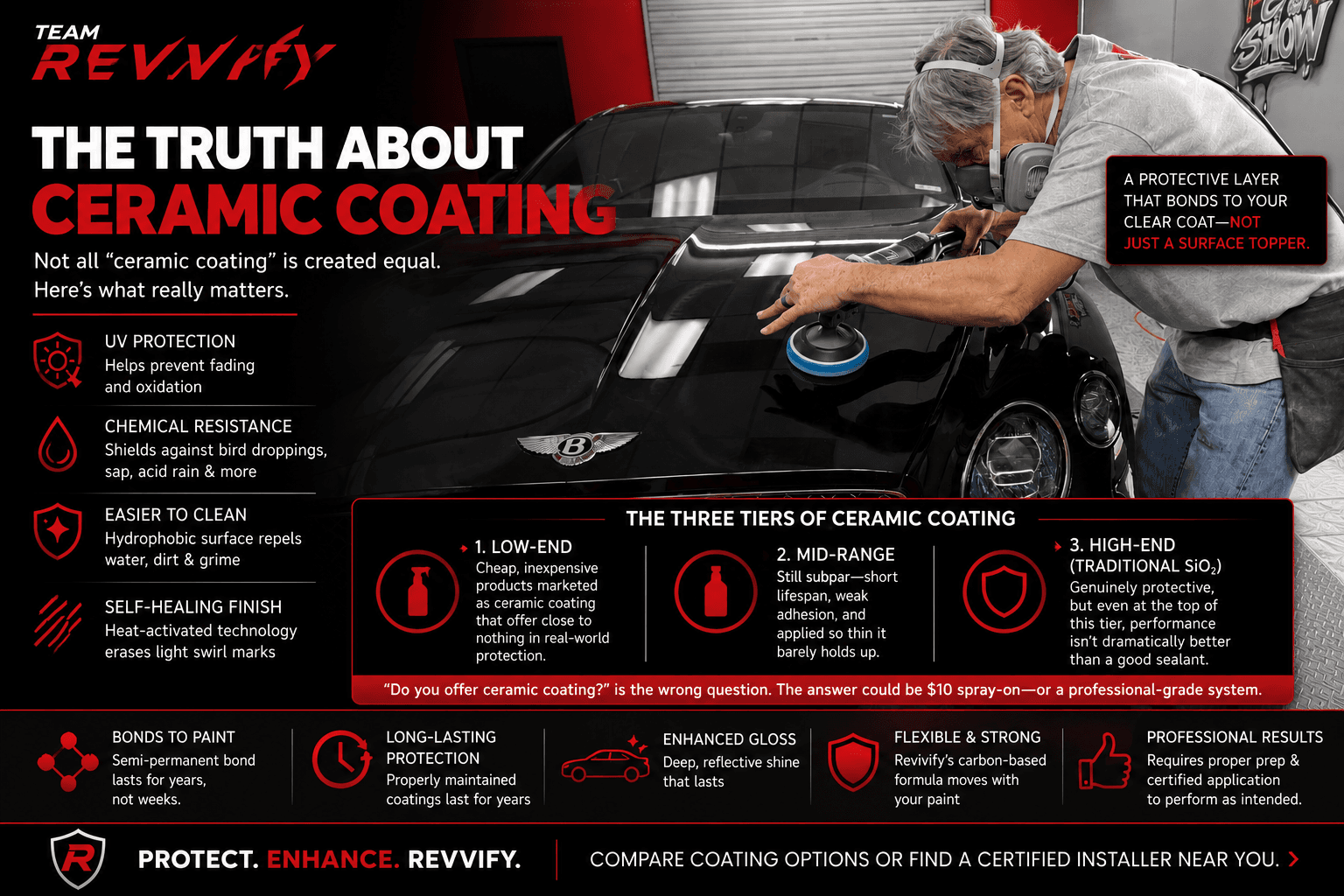
What Is Ceramic Coating? Why the Label Alone Doesn't Tell You Much
Ceramic coating is a liquid polymer applied by hand to a vehicle's exterior that chemically bonds to the clear coat, creating a semi-permanent protective layer. But "ceramic coating" isn't one product — it's a category that spans everything from a near-worthless spray bottle to a professionally applied, certified system, and the name alone won't tell you which one you're getting.
How is ceramic coating different from wax or sealant?
Wax is a surface topper — it adds shine and light water repellency but breaks down within months from washing, UV, and heat. Ceramic coating instead forms a cross-linked layer bonded to the clear coat itself, so it doesn't wash away the way wax does. That bond is also what gives coated paint its slickness: dirt, water, and contaminants have less surface area to grip onto.
What are the three tiers of ceramic coating?
Not all products sold as "ceramic coating" perform the same way. In practice, the market breaks down into three real tiers:
- Low-end: cheap, inexpensive products marketed as ceramic coating that offer close to nothing in real-world protection.
- Mid-range: still subpar — short lifespan, weak adhesion, and applied so thin it barely holds up.
- High-end (traditional SiO₂): genuinely protective, but even at the top of this tier, performance isn't dramatically better than a good high-end paint sealant.
This is why "do you offer ceramic coating" is the wrong question to ask a shop — the answer can describe an almost-worthless store-bought spray-on product just as easily as a professional-grade system.
What does ceramic coating actually protect against?
- UV rays that cause paint oxidation and fading — UV is the dominant weathering factor in coating appearance loss, and the factory clear coat is what shields the color coat from it
- Bird droppings, tree sap, and acid rain etching
- Road salt and general chemical staining
- Minor swirl marks, on formulas with self-healing properties
Does Ceramic Coating Stop Rock Chips?
No. Coating is a chemical layer, not a physical barrier, so it won't prevent a rock chip. See our full breakdown of ceramic coating vs. PPF for how the two actually compare on cost and long-term ownership.
Why does application matter as much as the product?
Ceramic coating performance depends heavily on surface prep and which tier of product is actually being used. Paint that isn't properly decontaminated and corrected before application traps existing swirl marks and contamination underneath the coating permanently. It's also worth knowing that many ceramic coating manufacturers today don't require any formal training or certification for installers — a major reason results vary so widely between shops even when the bottle says the same thing. That's why the Revivify application process begins with a multi-step wash, decontamination, and paint correction phase before any coating goes on, and why the product is sold only through certified applicators, not as a DIY kit or an unrestricted wholesale product.
FAQ
Is ceramic coating the same as ceramic tint?
No — ceramic tint is a window film product; ceramic coating is applied to painted body panels.
What's the real difference between low-end, mid-range, and high-end ceramic coating?
Low-end products offer close to no real protection, mid-range coatings are thin and short-lived with weak adhesion, and high-end traditional coatings genuinely protect — though even at that top tier, performance isn't dramatically better than a good sealant.
Do all ceramic coating brands require certified installers?
No. Many manufacturers sell ceramic coating with no training or certification requirement at all, which is a major reason results vary so much between installers even when they're using the same product.
Does ceramic coating make paint scratch-proof?
No coating is scratch-proof, but self-healing formulas can repair light swirl marks and fine scratches under heat exposure.
Can I apply ceramic coating myself?
Consumer "ceramic wax" products exist for DIY use, but professional-grade coatings like Revivify's require certified application to bond correctly and qualify for coverage.
What's the difference between SH Lite, Ultra Pro, and CarbonX?
They're tiered by protection level and durability — SH Lite is the entry option, Ultra Pro is the mid-tier, and CarbonX is the most protective, carbon-based formula.
Curious which coating tier fits your car? Compare Revivify's coating options or find a certified installer near you.
Sources
Find a certified Revivify installer near you
Self-healing protection backed by a multi-year, CARFAX-registered warranty — applied by trained, certified professionals.