
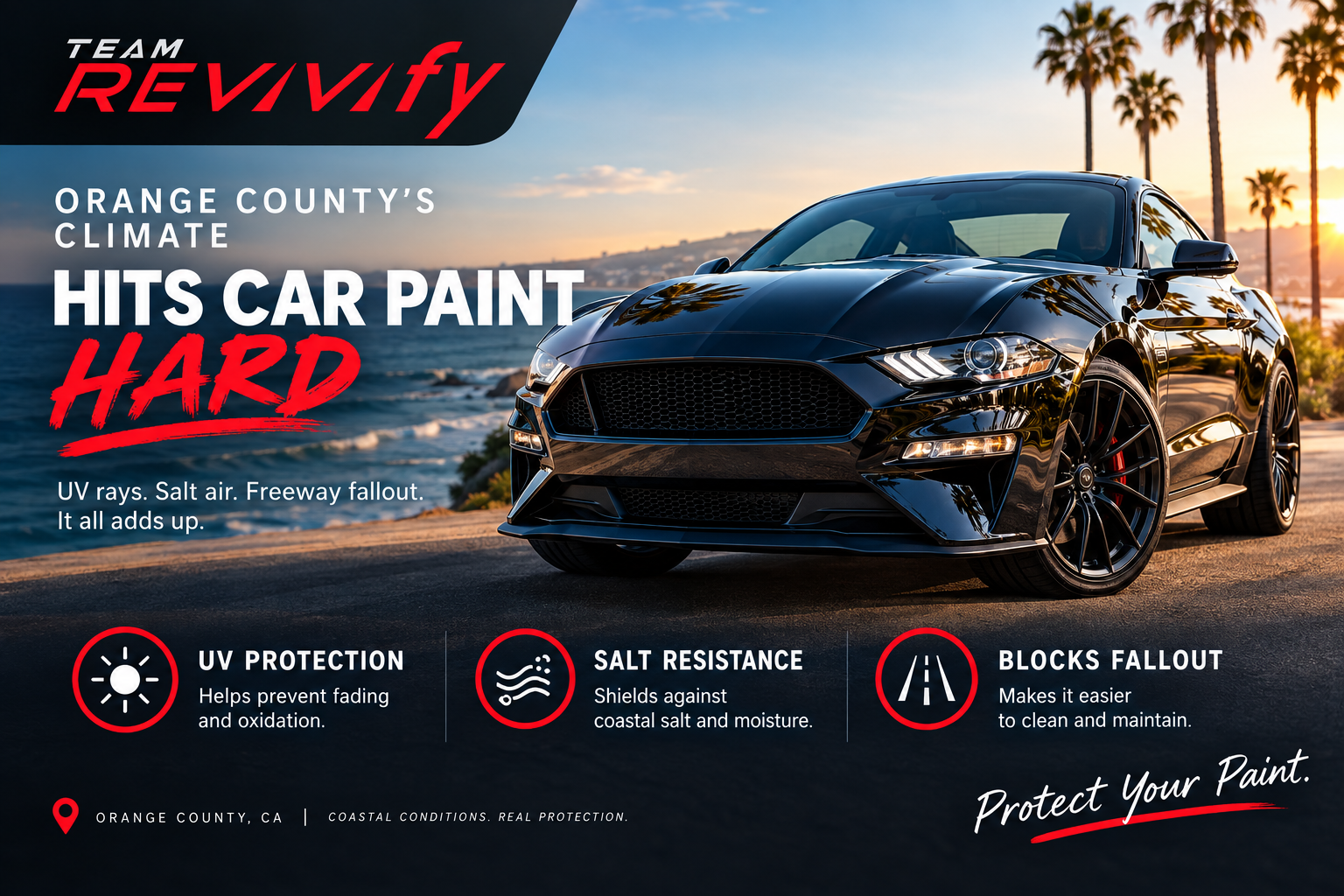
Orange County's climate is hard on car paint because it combines three accelerants at once: high-UV coastal sun, airborne salt from the ocean, and fine abrasive fallout from heavy freeway traffic. Together they oxidize clear coat, etch the surface, and dull the finish faster than the milder, drier conditions most paint warranties assume. A quality coating slows all three — and yes, real coatings protect paint, not just add shine.
If you park outside anywhere from Huntington Beach to Irvine, your paint is aging on the coastal clock, not the factory one. Here's the breakdown.
Last updated: September 2026
What in Orange County's climate damages car paint?
Three things, working together:
- UV exposure. Southern California sees more clear-sky sun-hours than most of the country. UV breaks down the resins in clear coat, which is what causes fading, chalking, and that hazy, lifeless look on older finishes.
- Salt air. Onshore breezes carry fine salt particles well inland. Salt holds moisture against the paint and speeds up oxidation, especially in seams, trim edges, and around badges.
- Freeway fallout. Brake dust, tire particles, and industrial iron settle on horizontal panels. Left on the surface, these embed and create tiny rust-colored specks that etch into the clear coat.
How fast does coastal sun fade clear coat?
Faster than most owners expect. Unprotected clear coat parked outdoors in a high-UV coastal environment can start showing measurable gloss loss within a couple of years, and visible oxidation on the roof, hood, and trunk — the panels that take the most direct sun — within three to five. Garage-kept cars age much slower, which is exactly why two identical models can look a decade apart.
Does salt air really reach cars parked miles from the beach?
Yes. You don't need to see the ocean for salt to reach your paint. On typical onshore-breeze days, measurable salt travels several miles inland across most of coastal Orange County. It's why cars here often show early corrosion spotting on unprotected chrome and bare-metal edges compared to inland valleys.
What actually protects paint in this climate?
A professionally applied protective coating is the practical answer for a daily-driven car. A coating adds a sacrificial layer that takes the UV, resists salt and chemical staining, and makes the surface slick enough that fallout rinses off before it can bond. Proper preparation matters as much as the product — the surface has to be decontaminated and corrected first, or the coating just seals existing damage in.
Revivify's self-healing coatings are built as a flexible alternative to traditional rigid ceramic. They flex with the panel through Southern California's heat cycling instead of micro-cracking, and minor swirls self-level with heat from the sun.
Is a self-healing coating better than ceramic for daily driving here?
For a car that lives outside and gets driven every day, flexibility is an advantage. Rigid ceramic coatings are hard and glossy but can become brittle over years of thermal expansion and contraction. A self-healing elastomeric coating like CarbonX stays pliable, so it holds up to the daily heat-soak-and-cool cycle that a car parked in an OC driveway goes through year-round.
Revivify is based in Huntington Beach and applies coatings on Orange County vehicles, boats, and aircraft through a trained applicator network.
FAQ
Do ceramic coatings actually protect paint or just add shine?
A quality professionally applied coating provides real, measurable protection — UV resistance, chemical and salt-stain resistance, and easier cleaning. The gloss is a side effect, not the main function. Retail spray-on "ceramic" products are a different story and offer far less.
How often should I wash my car in a coastal climate?
Every one to two weeks is a good target near the coast, to rinse salt and fallout before they bond. A coated car makes those washes faster because contamination releases more easily.
Will a coating stop rock chips on the freeway?
No. A coating is a chemical layer, not a physical barrier, so it won't stop a rock chip. It protects against UV, oxidation, staining, and light marring.
Is it too late to coat a car that already has sun damage?
Usually not. Paint correction can remove oxidation and light etching, and a coating applied over corrected paint locks in the restored finish. Deep clear-coat failure is the exception that correction can't fix.